
sizing
32/70 Bra Size Meaning: Bra Size Chart (70B = 32B) and How to Measure at Home
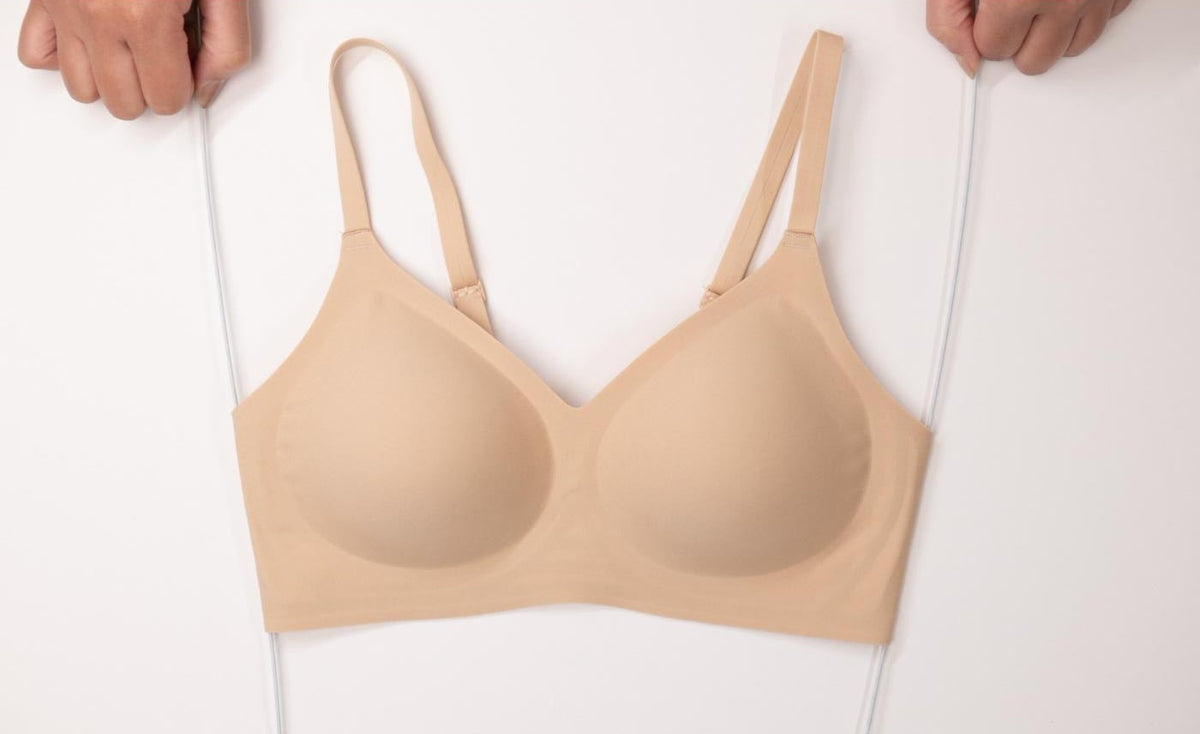
简短答案
Measure your underbust snugly and your bust at the fullest point, both in centimetres, then take the difference: about 10cm is an A cup, 12.5cm a B, 15cm a C, 17.5cm a D. Hong Kong and most Asian labels use the underbust number, so 70B is the same as a US 32B. For stretch-sized wireless bras like Kiri's XS to L, use the brand's chart rather than converting.
If you have ever wondered whether 70B is the same as 32B, it is. Asian bra sizing uses the underbust measurement in centimetres, while UK and US sizing uses inches, so the same bra carries two different names. This guide gives the full conversion chart, then walks through measuring yourself at home in about two minutes, with the fit checks that matter more than any number.
Bra size conversion chart
The cup letter stays the same across these systems (up to D). Only the band number changes, because Asian and European labels use the underbust in centimetres, the US and UK use inches, Australia uses its own band numbers, and France adds 15 to the centimetre band:
| Asian / EU (cm) | US / UK (in) | Australia / NZ | France | Example |
|---|---|---|---|---|
| 65 | 30 | 8 | 80 | 65C = 30C = AU 8C |
| 70 | 32 | 10 | 85 | 70B = 32B = AU 10B |
| 75 | 34 | 12 | 90 | 75B = 34B = AU 12B |
| 80 | 36 | 14 | 95 | 80A = 36A = AU 14A |
| 85 | 38 | 16 | 100 | 85B = 38B = AU 16B |
So 70B, 32B and Australian 10B are all the same size. If a label shows only one system, convert the band and keep the cup letter. Above a D, UK and US cup letters start to differ (a UK E is roughly a US DDD), so check the brand's own chart for larger cups. A few older US charts also add four or five inches to the underbust before assigning a band, which is one reason the same person can be a different size in different brands.
What does 32/70 mean on a bra label?
A label like 32/70 simply prints the same band in two systems: 32 inches (US/UK) and 70 cm (Asian/European). It fits an underbust of roughly 68–72 cm, or about 27–28 inches measured snugly.
When a cup is written as AB (for example 32/70 AB or 32AB), the bra is designed to fit both A and B cups. You'll mostly see this on stretchy, wire-free and sports bras, where the fabric adapts to a range of shapes. Read it as "70A or 70B". A 32/70 B label is the same as 70B and 32B.
32B in centimetres, and in S/M/L
A 32B (70B) usually means an underbust of about 68–72 cm and a bust of about 80–85 cm: the band plus roughly 12.5 cm for a B cup. The same band with an A cup has a bust of about 78–82 cm, and with a C cup about 83–87 cm.
Letter sizes aren't standard between brands, so always check the brand's chart. In Kiri's chart:
| Kiri size | Asian | US / UK |
|---|---|---|
| XS | 65C · 70B · 75A | 30C · 32B · 34A |
| S | 70C · 75B · 80A | 32C · 34B · 36A |
| M | 75C · 80B · 85A | 34C · 36B · 38A |
| L | 80C · 85B · 90A | 36C · 38B · 40A |
So a 32B or 70B is a Kiri XS, and a 34B or 75B is a Kiri S. Each Kiri size covers three "sister sizes" (explained below).
What you need
A soft measuring tape and a mirror. No tape? A piece of string and a ruler work too. Measure without a bra, or in a thin unpadded one, because padding adds centimetres to your bust measurement. Avoid the few days just before your period, when breast tissue can be temporarily swollen (here's why).
Step 1: Measure your underbust (band size)
Wrap the tape directly under your bust, where a bra band sits. Keep it snug but not tight, and level all the way around; use the mirror to check it isn't rising at the back. Breathe out normally and read the number. This is your underbust, and it sets your band size.
- Centimetres (Asian and European sizing): round to the nearest 5. An underbust of 68–72 cm is a 70 band; 73–77 cm is a 75 band.
- Inches (UK and US sizing): many brands round your underbust to the nearest even number, so 31.5 inches becomes a 32 band.
Step 2: Measure your bust
Wrap the tape around the fullest part of your bust, usually across the nipples. Keep it level and resting on the skin without compressing anything. This is your bust measurement.
Step 3: Work out your cup size
Subtract your underbust from your bust. The difference gives your cup letter:
| Cup | Difference (Asian sizing, cm) | Difference (UK/US, inches) |
|---|---|---|
| A | about 10 cm | 1 in |
| B | about 12.5 cm | 2 in |
| C | about 15 cm | 3 in |
| D | about 17.5 cm | 4 in |
| E / DD | about 20 cm | 5 in |
Put the two together: an underbust of 71 cm (a 70 band) and a bust of 83.5 cm (a 12.5 cm difference) is a 70B — or, in UK/US sizing, a 32B. Treat the result as a starting point rather than a verdict. Breast shape, cup depth and each brand's pattern all shift the real fit a little.
Sister sizes: why one number isn't the whole story
Cup letters aren't fixed volumes; they're relative to the band. Going up one band size and down one cup letter keeps roughly the same cup volume, so 70C, 75B and 80A are "sister sizes". That's why one bra size can cover several band-and-cup combinations, and why, if the band feels tight but the cups fit, the usual fix is the sister size (up a band, down a cup) rather than a completely different bra.
Fit checks that matter more than the tape
- The band sits level and doesn't ride up at the back. Most of a bra's support comes from the band, not the straps.
- Two fingers fit under the band, but not much more.
- The cups hold everything without gaping at the top or spilling over the edges.
- The straps stay put without digging in. If they're doing the heavy lifting, the band is too loose.
- It still feels fine at 6pm. A bra that's comfortable in a fitting room but not after a full day isn't the right fit.
Common measuring mistakes
- Measuring over a padded or push-up bra.
- Pulling the tape tight to get a smaller number.
- Letting the tape slope down at the back.
- Relying on a size from years ago. Weight changes, pregnancy and age all change your size.
Sizing a wireless bra
Wire-free styles like Kiri's Every Day Bra hold their shape with four-way stretch fabric rather than a rigid wire, so they're more forgiving between sizes. If you're between two sizes in a wireless style, size up: the stretch takes up any extra room, while a band that's too tight simply digs in. (Period underwear is the opposite: size down.) Our size guide shows which Asian and US/UK sizes fall into each of our sizes — XS covers 70B and 32B, S covers 75B and 34B — and wireless vs underwire explains how the two support you differently.
When to remeasure
Remeasure after any noticeable weight change, during and after pregnancy or breastfeeding (see what changes after baby), or if it's been more than a year. If your bras have started to dig, gap or ride up, that's usually the sign.
Prefer to see it in person?
You can try the stretch and feel the fabric of our Every Day Bras at our display inside Blomstre, Shop 401, 4/F C & D, Hopewell Mall, Wan Chai. It's open Monday to Sunday, 12pm to 9pm, with no appointment needed. Directions and details.
Keep reading
常见问题
How do I measure my bra size at home?
Use a soft tape. Measure snugly around your ribcage just under the bust, then loosely around the fullest part of the bust, both level and in centimetres. The underbust gives your band, and the difference between the two gives your cup: about 10cm is an A, 12.5cm a B, 15cm a C, 17.5cm a D.
Is 70B the same as 32B?
Yes. Hong Kong and most Asian labels use the underbust measurement in centimetres, while US and UK labels use inches. 70cm is about 32 inches, so 70B and 32B are the same size.
What does 32/70 AB mean on a bra label?
32/70 is the same band written in inches (32) and centimetres (70), for an underbust of about 68–72 cm. AB means the cup is designed to fit both A and B cups, which is common on stretchy wire-free and sports bras.
What if I am between two sizes?
For a wired bra, go with the smaller band and the larger cup. For a stretch-sized wireless bra like Kiri's, size up: four-way stretch takes up any extra room, while a band that is too tight simply digs in. Period underwear is the opposite: if you are between sizes there, size down.
Is 10B the same as 32B?
Yes. Australian band sizes run 8, 10, 12, 14, so an AU 10B is a US/UK 32B and an Asian 70B.
What is 34B in Asian sizing?
75B. Convert the band (34 inches is a 75 cm band) and keep the cup letter.
Is a 32 band the same as a 32-inch bust?
No. The 32 refers to the band, which sits under the bust. A 32B usually has a bust measurement of about 80–85 cm (31.5–33.5 inches), measured at the fullest point.
Is band size or cup size more important?
Band size. It provides most of the support, and getting it right usually fixes strap and cup problems too.
Why am I a different size in different brands?
Brands use different sizing systems (centimetres or inches, with or without adding to the underbust) and different patterns. Always check your measurements against a brand's own chart.


